HR today faces more complexity than ever as teams juggle multiple tools for sourcing, screening, onboarding, payroll, performance, and engagement. As a result, they often drown in technology with no satisfactory results in sight. Legacy HR systems slow down productivity and increase cybersecurity and legal risks. They also crash frequently. These outdated systems cost the business time and money. Moreover, relying on old technology stops you from scaling and optimizing operational efficiency at its peak. This is exactly where modern HR teams must start caring about building a Composable HR Stack. It helps them integrate different systems that historically worked in silos, and it creates a unified and agile HR ecosystem.
What is a Composable HR Stack?
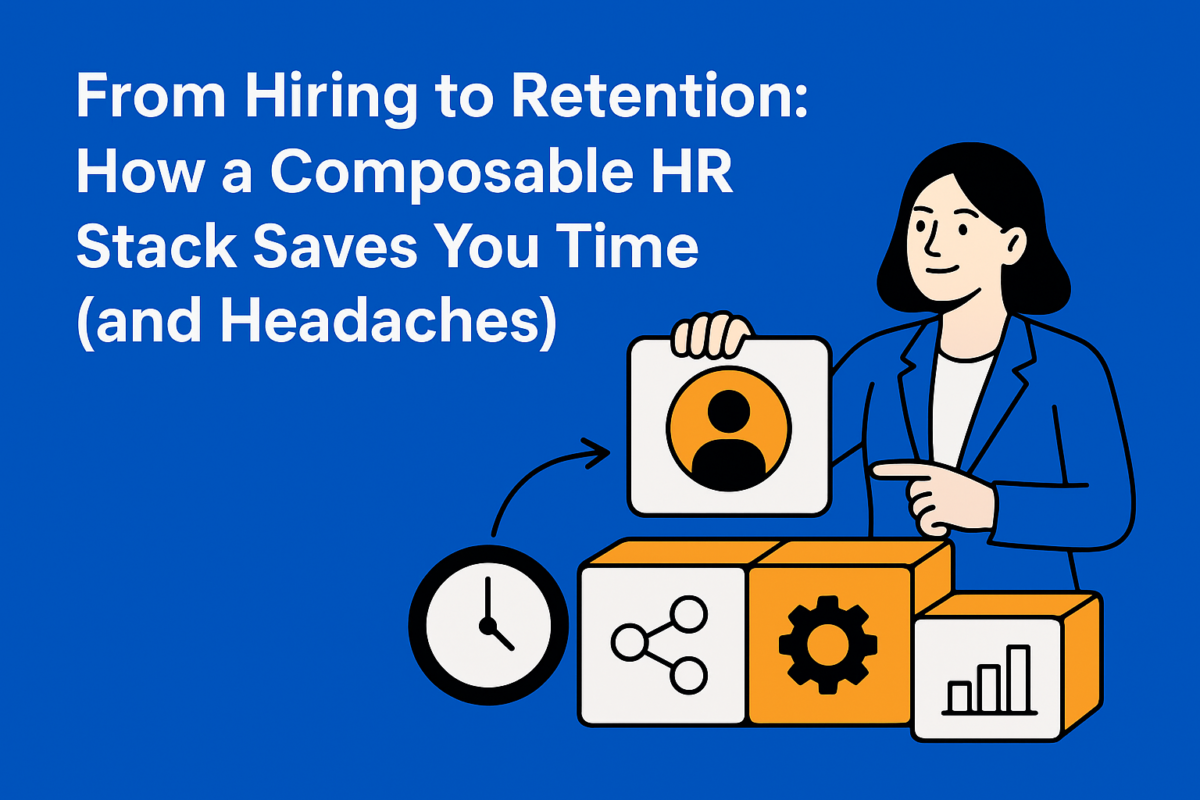
Think of your HR as an ecosystem you build block-by-block in a customizable, plug-and-play manner, not as a monolithic platform. With AI-driven HR technology, you can choose the best tool for each specific function instead of sticking to whatever your third-party vendor or rigid HRM suite offers. These traditional systems rarely cater to the unique needs of complex organizations.
Modern organizations increasingly rely on modular HR systems to grow efficiently. Composable applications allow organizations to create their own HR stack by integrating all tools seamlessly through no-code APIs. As a result, HR teams gain flexibility, scalability, and customization without locking themselves into one vendor or platform.
Unified Database
An HR application framework is the way forward to monitor and assess employee journeys. Each tool under the API communicates and syncs candidate data smoothly across the system. Once you update an employee’s records in one tool, the information automatically reflects in other connected systems. This eliminates redundancy, prevents inconsistencies, and reduces clerical work.
Faster Hiring
Specialized tools for sourcing and screening speed up the recruiting process by automating tests, behavioral assessments, and AI-driven screening. When you plug in these purpose-specific tools, they instantly rank candidates for review. Consequently, hiring time decreases, and your team can focus on interviews and relationship-building. By integrating AI-driven HR tools, teams shorten hiring cycles significantly.
Improved Employee Experience
The first day of an employee matters. A smooth onboarding process sets the tone, and a composable HR stack transforms onboarding into a connected and seamless journey. From digital documents to IT provisioning requests and compliance steps, the onboarding workflow moves automatically. This creates a hassle-free first-day experience for the employee. Additionally, teams can start engagement on Day 1 without wasting time facilitating joining formalities.
Scale Your Business Without Rebooting the Entire System
As your business grows and your vision evolves, scaling becomes necessary. Legacy HR systems rarely grow with you, and their rigidity holds back your expansion plans. With a composable HR stack, HR teams gain the agility to customize workflows. For example, you can switch to a new learning system to upskill your workforce without replacing your entire HRIS. This flexibility becomes possible only in an HR application framework where every subset is modular and integration-ready.
Reliable Insights Into Employee Management
When employee data interacts within a connected system, HR teams gain deeper visibility. Every data point—performance, attendance, survey responses—can be mapped inside the composable HR stack. As a result, you can derive actionable insights, spot trends, and predict attrition more accurately.
Not Complex, but Optimally Stacked
Teams can plug in and swap tools to create customizable solutions that manage the workforce efficiently. Automations take it further by letting non-tech users build workflows through a no-code interface. Your HR team doesn’t need a “Coding for Beginners” crash course to run these platforms. In fact, the plug-and-play feature becomes one of the greatest superpowers a modern HR team can have.
Composable HR Stack Is Here to Stay
A composable HR stack represents the future of talent technology for organizations looking to scale, become more agile, increase accuracy, and prioritize employee experience. AI-driven composable HR systems help HR teams become proactive. Ability Stack builds its platform around the modular nature of HR work.
Ability Stack strengthens this approach with a modular workforce management platform. It is a modular platform designed to innovate HR tech—an all-in-one integrated talent sourcing and workforce management platform.
Healthcare hiring is uniquely complex, with credential tracking, agency coordination, and shift-based staffing. Learn how unified ATS + VMS systems help healthcare organizations reduce time-to-fill, improve compliance, and lower agency dependency.
Disconnected hiring systems slow down recruitment. Learn how ATS VMS integration reduces time-to-fill by 30% through automated workflows, unified reporting, and better visibility across permanent and contingent hiring.